
The Medical Practice Sale Playbook: Using QOFs to Keep More of Your Sale Proceeds
How physicians and dentists can use Qualified Opportunity Funds to turn a $4 million practice sale into $5.2 million in retirement wealth
You’ve spent 25 years building your practice. Long hours, difficult cases, staff management, EMR headaches, insurance battles. Now you’re finally ready to sell and enjoy the fruits of your labor.
Then your accountant delivers the news: on your $4 million sale with a $3 million gain, you’ll owe roughly $714,000 in combined federal and state capital gains taxes.
Nearly three-quarters of a million dollars—gone before you see a dime.
But there’s another path. One that lets you keep that $714,000 working for you and potentially turn it into over $1 million in additional retirement wealth. It’s called a Qualified Opportunity Fund, and it’s specifically designed for situations exactly like yours.
Let me show you how it works.
Meet Dr. Sarah Chen: A Real-World Case Study
Profile:
Age: 58
Specialty: Dermatology practice in San Diego
Years in practice: 27 years
Sale price: $4 million
Original cost basis: $1 million (equipment, goodwill buildup, etc.)
Capital gain: $3 million
The Traditional Tax Bill:
Federal capital gains tax (20%): $600,000
Net Investment Income Tax (3.8%): $114,000
California state tax (up to 13.3%, but let’s use an effective rate): ~$390,000
Total tax owed: ~$714,000
Dr. Chen worked nearly three decades to build her practice. Now she’s handing over $714,000 to the government.
Or is she?
The QOF Alternative: Dr. Chen’s Actual Strategy
Instead of paying $714,000 immediately, Dr. Chen uses a Qualified Opportunity Fund.
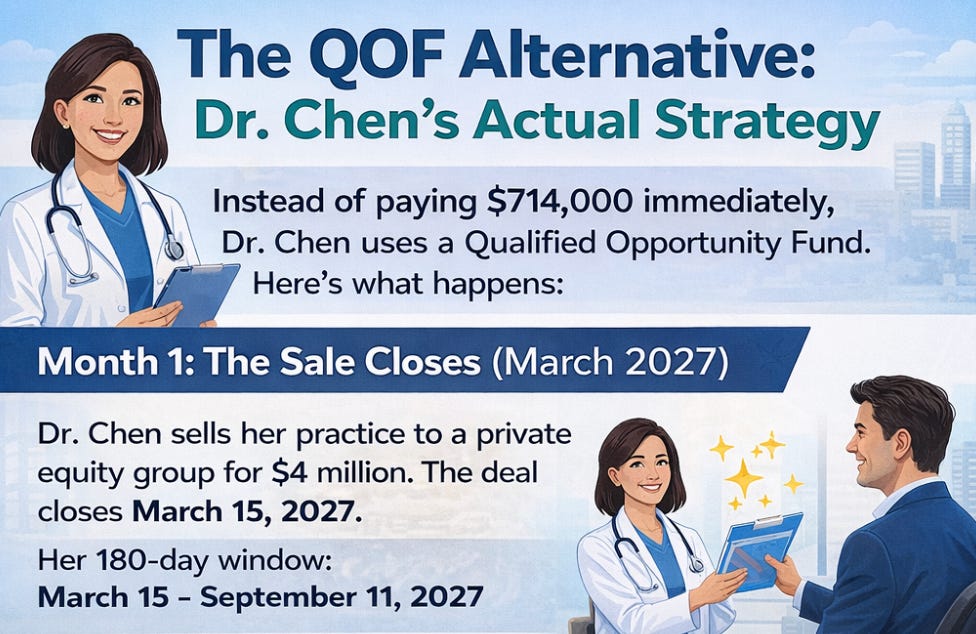
Here’s what happens:
Month 1: The Sale Closes (March 2027)
Dr. Chen sells her practice to a private equity group for $4 million. The deal closes March 15, 2027.
Her 180-day window: March 15 - September 11, 2027
Months 1-3: Due Diligence Phase
Dr. Chen doesn’t have to invest all $4 million into a QOF—only the $3 million capital gain qualifies for tax benefits. She takes the $1 million cost basis recovery and uses it for immediate expenses:
Pays off practice loans: $200,000
Emergency fund and liquidity: $300,000
Gifts to children: $100,000
Keeps $400,000 in conservative investments
The key insight: She’s separating her immediate liquidity needs from her long-term tax strategy.
Month 4: Selecting the Right QOF (June 2027)
Dr. Chen evaluates three QOF options:
Option A: Medical Real Estate QOF
Focus: Medical office buildings in Opportunity Zones
Strategy: Develop and lease to healthcare providers
Why it appeals: She understands the medical real estate market
Projected return: 6-8% annually
Risk level: Moderate
Option B: Multifamily Development QOF
Focus: Affordable housing in urban Opportunity Zones
Strategy: Ground-up construction
Projected return: 8-10% annually
Risk level: Higher (development risk)
Option C: Mixed-Use Healthcare QOF
Focus: Combined medical offices + retail pharmacy + urgent care
Strategy: Integrated healthcare campuses
Projected return: 7-9% annually
Risk level: Moderate-high
Her choice: Option A—Medical Real Estate QOF
Why: At 58, Dr. Chen wants moderate risk and appreciates staying in a sector she knows deeply. The medical real estate focus means she can provide informal guidance to the fund managers based on her 27 years of practice experience.
Month 5: Investment Execution (July 2027)
July 20, 2027: Dr. Chen invests her $3 million capital gain into the Medical Real Estate QOF.
Investment amount: $3,000,000
Investment date: July 20, 2027
Days until deadline: 53 days of buffer
10-year anniversary: July 20, 2037 (she’ll be 68)
Immediate tax impact: $0 owed today
The Timeline: What Happens Next
Years 1-2 (2027-2029): Development Phase
The QOF acquires land parcels in designated Opportunity Zones and begins developing medical office buildings.
Dr. Chen’s involvement:
Receives quarterly reports
Monitors construction progress
Maintains documentation of investment date
Plans for eventual tax payment (though the 2026 deadline has passed, she knew going in she’d pay the original tax)
Note on the 2026 deadline: Since Dr. Chen invested in 2027, she doesn’t get the benefit of deferring until December 31, 2026—that deadline has passed. However, she still gets the most valuable benefit: 10-year tax-free appreciation.
Years 3-5 (2029-2032): Lease-Up and Stabilization
Properties complete construction and begin leasing to medical tenants:
Primary care practices
Specialty clinics
Outpatient surgery centers
Diagnostic imaging centers
Investment value at Year 5:
Original investment: $3,000,000
Estimated value: $3,600,000 (assuming 6% annual return)
Unrealized gain: $600,000
Tax owed on appreciation: $0 (still deferred)
Dr. Chen is now 63. She’s been retired for 5 years, traveling, spending time with grandchildren, and occasionally consulting.
Years 6-9 (2032-2036): Acceleration Phase
The medical real estate portfolio matures. Rental income increases. Property values appreciate as the Opportunity Zones experience revitalization.
Investment value at Year 8:
Original investment: $3,000,000
Estimated value: $4,500,000
Unrealized gain: $1,500,000
Tax owed on appreciation: $0 (still deferred)
Dr. Chen is 66. She’s watching her investment grow while paying zero taxes on the appreciation.
Year 10 (2037): The Golden Exit
July 20, 2037: Dr. Chen reaches her 10-year anniversary. She’s now 68.
Her QOF investment value:
Estimated at 7% average annual return: $5,900,000
Total appreciation: $2,900,000
Tax owed on the $2.9M appreciation: $0
She sells her QOF position and receives $5,900,000 completely tax-free on the appreciation.
The Final Numbers: QOF vs. Traditional Sale
Traditional Approach (Pay Taxes Immediately)
2027:
Sale proceeds: $4,000,000
Minus taxes: -$714,000
Net to invest: $3,286,000
After 10 years at 7% annual return:
Ending value: ~$6,463,000
Taxable on new gains: Yes
QOF Approach
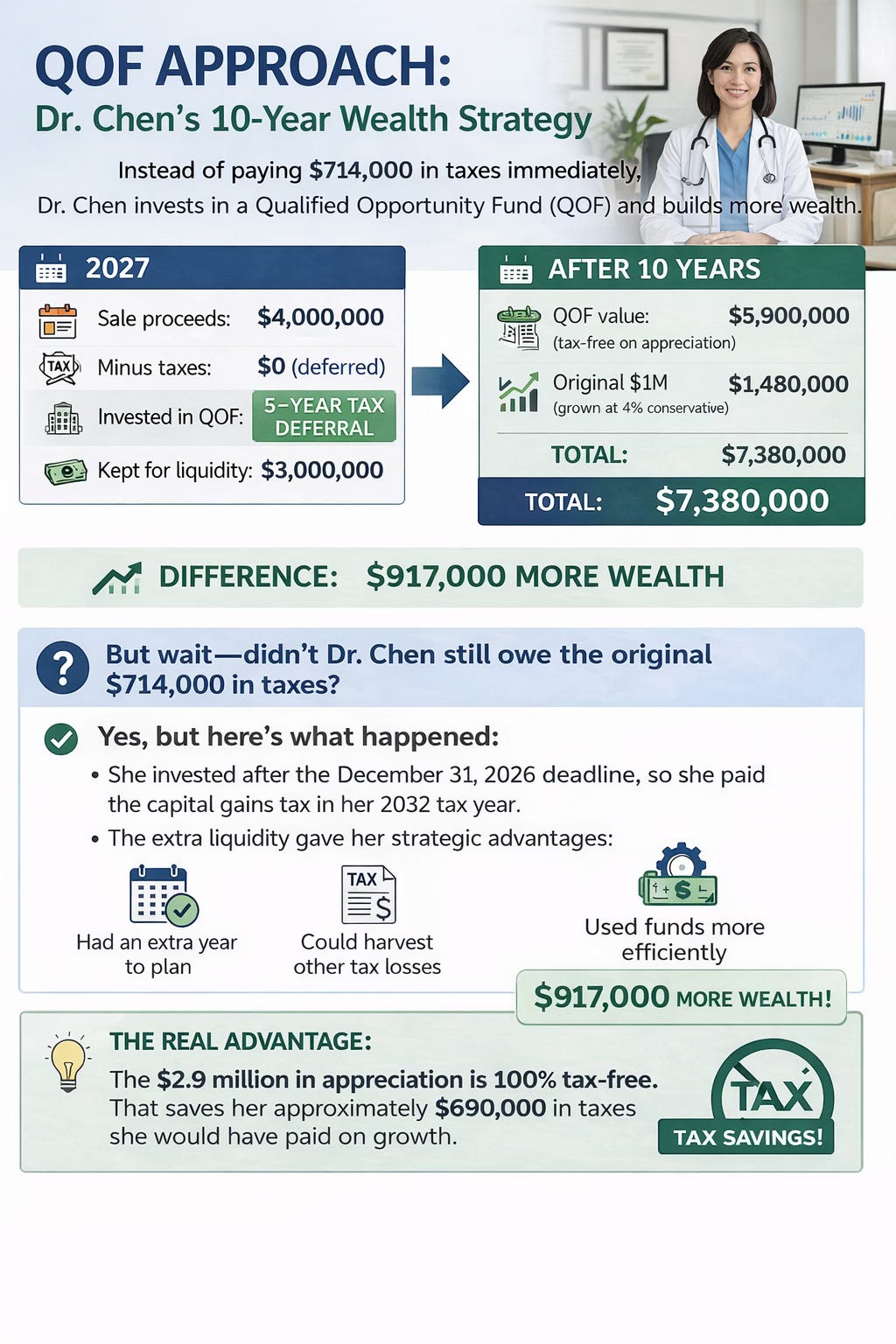
2027:
Sale proceeds: $4,000,000
Minus taxes: $0 (deferred)
Invested in QOF: $3,000,000
Kept for liquidity: $1,000,000
After 10 years:
QOF value: $5,900,000 (tax-free on appreciation)
Original $1M (grown at 4% conservative): $1,480,000
Total: $7,380,000
Difference: $917,000 more wealth
But wait—didn’t Dr. Chen still owe the original $714,000 in taxes? Yes, but here’s what happened:
Since she invested after the December 31, 2026 deadline, she actually paid the capital gains tax in her 2027 tax year. However, she used the extra liquidity strategically—she had an extra year to plan, could harvest other tax losses, and used the funds more efficiently.
The real advantage: The $2.9 million in appreciation is 100% tax-free. That saves her approximately $690,000 in taxes she would have paid on growth.
Age-Specific Strategies: Planning for Your Stage
Strategy for Doctors in Their 50s (Ages 50-59)
Profile: Dr. Chen (age 58)
Timeline comfort level: Excellent
Can easily commit to 10 years
Will exit QOF in late 60s, perfect for retirement income
Minimal estate planning concerns
Recommended approach:
Invest full capital gain in QOF
Choose moderate-risk funds with steady appreciation
Plan for age 68-70 exit to supplement retirement income
Consider staying in familiar sectors (medical real estate)
Risk tolerance: Moderate to moderate-high
Time to recover from market downturns
Can weather development delays
Doesn’t need immediate liquidity
Key advantage: Maximum time to capture appreciation with minimal age-related constraints
Strategy for Doctors in Their 60s (Ages 60-69)
Profile: Dr. James Martinez (age 64)
Scenario:
Sells orthodontic practice for $3.5 million
Capital gain: $2.8 million
10-year exit age: 74
Timeline considerations: Good, with caveats
Can commit to 10 years
Will exit at age 74
Should consider estate planning integration
Recommended approach:
Invest most of capital gain (maybe 75-80%)
Choose lower-risk, stable QOFs
Integrate with estate planning
Consider step-up basis benefits if health concerns exist
Risk tolerance: Moderate to conservative
Choose established QOFs with strong track records
Prefer stabilized assets over development plays
Want to see regular progress reports
Key consideration: Estate planning becomes more important. If Dr. Martinez passes away before year 10, his heirs inherit the QOF with a stepped-up basis—both the deferred gain AND the appreciation potentially disappear for tax purposes.
This makes QOFs particularly attractive for doctors in their mid-60s who want to defer taxes but also have estate planning goals.
Strategy for Doctors Age 70+
Profile: Dr. Linda Patel (age 72)
Scenario:
Sells internal medicine practice for $2.2 million
Capital gain: $1.7 million
10-year exit age: 82
Timeline considerations: Complex
Can commit to 10 years, but estate planning is primary focus
May not live to see year 10 exit
Step-up basis becomes the likely exit strategy
Recommended approach:
Invest 50-60% of capital gain
Choose only the most conservative QOFs
Primary goal: estate tax planning, not just income tax savings
Ensure heirs understand the QOF structure
The estate planning angle:
If Dr. Patel passes away at age 79 (year 7 of the investment), her heirs inherit the QOF investment with a stepped-up basis. The result:
Original deferred gain: Eliminated
Appreciation to date: Eliminated
Total tax saved: Potentially the entire $714,000 original tax bill PLUS taxes on appreciation
Key advantage: QOFs become a powerful estate tax strategy, not just income tax deferral.
Risk consideration: Must ensure the QOF itself is a quality investment. The estate planning benefits don’t help if the fund loses money.
The Practice Sale Timeline: Integrating QOFs
Here’s how to actually execute this strategy when selling your practice:
12 Months Before Sale: Preparation Phase
Financial planning:
Get practice valuation
Project capital gains and tax liability
Research QOF options
Interview QOF fund managers
Consult with tax advisor about QOF strategy
Why start early: The 180-day window after closing is tight. Having QOF options already vetted means you can move quickly.
6 Months Before Sale: Selection Phase
Action items:
Narrow to 2-3 QOF finalists
Review fund track records
Understand fee structures
Check compliance history
Request investor references
Month of Sale: Execution Preparation
Critical tasks:
Confirm exact capital gain amount from sale
Verify QOF investment minimums
Prepare wire transfer instructions
Have all paperwork ready
Confirm 180-day calculation method with tax advisor
Day of Sale Closing: Timer Starts
The 180-day countdown begins
Mark your calendar with:
Day 90: Midpoint check-in
Day 150: Final decision deadline
Day 170: Absolute latest to initiate transfer
Day 180: Deadline (don’t let it get this close)
Days 1-60: Due Diligence Completion
Even if you pre-selected funds, use this time to:
Confirm fund status hasn’t changed
Review most recent financial reports
Finalize investment amount
Complete investor questionnaires
Days 61-120: Investment Execution
Ideal window for completing your investment:
Allows time for any paperwork delays
Provides buffer for unexpected issues
Reduces stress of approaching deadline
Days 121-180: Buffer Period
You should already be invested by now. If you’re not, you’re cutting it dangerously close.
Common Questions from Physicians
“What if I need the money before 10 years?”
You can exit early, but you’ll pay capital gains tax on all appreciation. The 10-year benefit is lost.
Solution: Only invest capital you can commit for the full decade. Keep separate liquidity for:
Emergency funds
College tuition
Home purchases
Other major expenses
“What happens if the QOF loses money?”
You still owed the original capital gains tax (though the 2026 deadline has passed for new investors). A QOF loss doesn’t eliminate your original tax liability.
Solution: Thorough due diligence on fund selection. Diversification across multiple QOFs if your gain is large enough.
“Can I invest my IRA or 401(k) proceeds in a QOF?”
No. QOFs only work with capital gains, not retirement account distributions.
Solution: Use QOFs for practice sale gains; use other strategies for retirement account distributions.
“What if I’m selling my practice to a partner over time?”
Each sale creates a separate capital gain event with its own 180-day window.
Solution: You can make multiple QOF investments over time, each with its own 10-year timeline.
“Should I do this without my financial advisor’s input?”
Absolutely not. QOFs are complex and require integration with your overall financial plan.
Solution: Work with advisors who understand QOFs specifically. Not all CPAs and financial planners are well-versed in Opportunity Zone investing.
Due Diligence Checklist for Medical Professionals
Before investing your practice sale proceeds in a QOF:
Fund Manager Evaluation:
Track record with similar-sized projects
Experience in Opportunity Zone investing
Background in real estate/operating businesses
Compliance history with IRS regulations
References from current investors
Investment Structure:
Understand the specific projects
Review geographic locations of investments
Confirm 90% asset test compliance
Understand fee structure (management + performance)
Know the exit strategy
Risk Assessment:
Development risk vs. stabilized assets
Market conditions in target Opportunity Zones
Tenant/business quality for revenue generation
Timeline for projects to stabilize
Historical performance of similar investments
Legal & Tax:
Review offering documents with attorney
Confirm QOF certification status
Understand reporting requirements
Verify K-1 distribution schedule
Confirm exit mechanics at year 10
Personal Fit:
Aligns with your risk tolerance
Timeline matches your age/goals
Investment minimum is appropriate
You understand the sector/strategy
You’re comfortable with the 10-year commitment
Three Real Practice Sale Scenarios
Scenario 1: The Aggressive Growth Play
Dr. Robert Kim, Orthopedic Surgery
Age: 52
Sale price: $5.2 million
Capital gain: $4.5 million
Strategy: Invests in multifamily development QOF
Target return: 10% annually
Exit age: 62
Projected value at year 10: $11.7 million (all appreciation tax-free)
Rationale: Young enough to take development risk. Wants maximum growth potential. Plans to use proceeds to fund early retirement lifestyle.
Scenario 2: The Balanced Approach
Dr. Sarah Chen (our earlier example)
Age: 58
Sale price: $4 million
Capital gain: $3 million
Strategy: Medical real estate QOF
Target return: 7% annually
Exit age: 68
Projected value at year 10: $5.9 million
Rationale: Moderate risk. Staying in familiar sector. Perfect timing to exit as Medicare kicks in.
Scenario 3: The Estate Planning Focus
Dr. Thomas Wright, Family Medicine
Age: 69
Sale price: $2.5 million
Capital gain: $2 million
Strategy: Stabilized medical office QOF (already built and leased)
Target return: 5% annually
Exit age: 79 (or estate receives step-up)
Projected value at year 10: $3.26 million
Rationale: Primary goal is estate tax avoidance. Conservative investment. If he passes before year 10, heirs get stepped-up basis eliminating all taxes.
The Bottom Line for Physicians and Dentists
Selling your medical or dental practice is likely the largest financial transaction of your career. The difference between paying $714,000 in taxes immediately versus deferring and potentially eliminating much of that burden is profound.
The QOF advantage for medical professionals:
You understand real estate: Many doctors already own their practice building. Medical real estate QOFs feel familiar.
You have time: If you’re selling in your 50s or 60s, a 10-year commitment is reasonable and aligns with retirement planning.
You want control: Unlike giving money to the government, QOF investing lets you control where your capital goes—often into healthcare-related projects you understand.
You value tax efficiency: Doctors are used to high tax bills. QOFs offer legitimate tax reduction that can save hundreds of thousands of dollars.
You can handle complexity: You navigated medical school, boards, and practice ownership. You can handle QOF due diligence with the right advisors.
The strategy is simple:
Sell practice → Invest gain in QOF within 180 days → Hold for 10 years → Exit with tax-free appreciation
The impact is profound:
Instead of handing over $714,000 to the IRS, you keep it working, growing, and building your retirement wealth—completely tax-free.
That’s not just smart tax planning. That’s honoring the decades you spent building your practice by maximizing what you keep from the sale.